
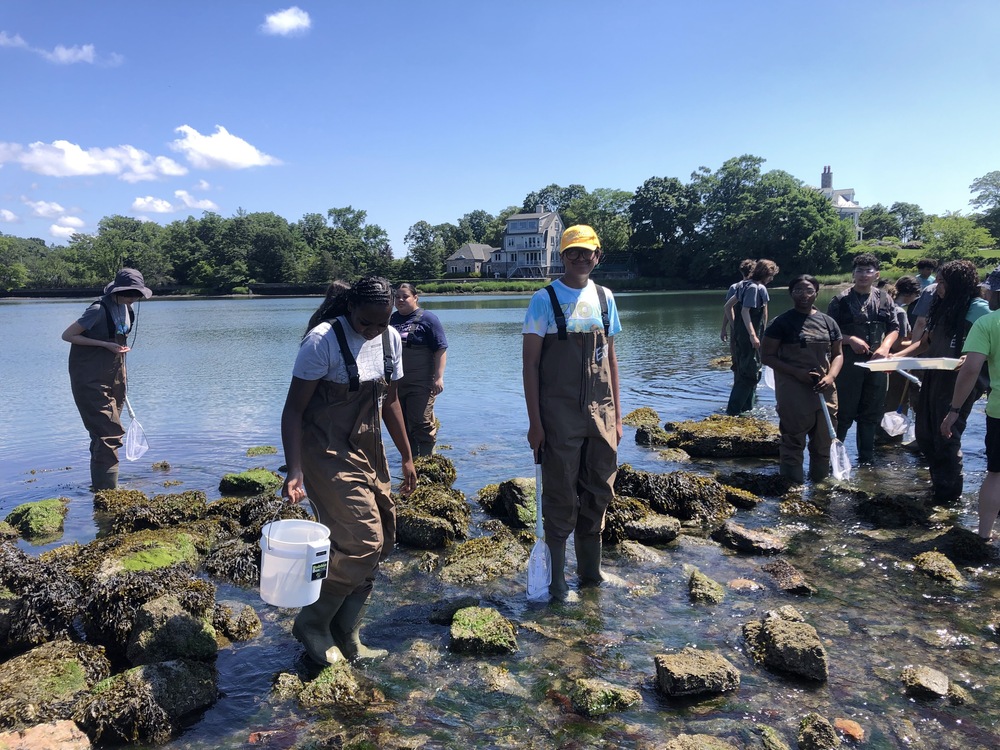
While many high school students spent the summer working in camps or retail stores or just lounging by a pool, a select group of New Rochelle High School students were working for the New Rochelle Youth Bureau as Eco Ambassadors at Five Islands Park.
As Eco Ambassadors, the students spent six weeks learning techniques for monitoring water quality and observing and cataloguing marine life such as crabs, oysters, mussels, and many other marine species. They also learned how to incorporate technology to gain a greater understanding of what can lie beneath the surface of the water, all under the guidance of New Rochelle science teachers Jonathan LaRosa and Carmen Glenn.
To participate, students had to apply to the “Learn and Earn” program offered by the Youth Bureau of New Rochelle. In all, there were 18 students and three college interns who are usually New Rochelle graduates.
“The program also featured field trips, guest speakers and a culminating research project,” said LaRosa, who has been running Eco Ambassadors for five years. “It is a pretty robust program designed to expose students to marine science.”
While the program doesn’t track participants, students have gone on to study environmental science, animal science, and marine science at their respective colleges. It has also driven students to become interested in joining Glenn's Green Club at New Rochelle High School, where they continue to practice environmental activism.
Among other things, students learned how to use a seine net to sample small fish and other nearshore aquatic life. They also monitored oyster, ribbed mussel, fiddler crab, Asian shore crab, and native mud crab populations in the salt marsh.
Students used a SeaPerch submersible robot, which was built by a group of students last year, and sonar devices to gather data by combining the two technologies. The students finished their six-week experience with a gallery walk of six outstanding projects. They were honored at New Rochelle City Hall and received certificates from local officials for their hard work.
The program is funded through a grant from the Long Island Sound Community Impact fund. The grant was secured through our partnership with the Energy Justice Law and Policy Center.